

Twenty People, One Picture: What I actually Watch For at a "Sip and Paint" type corporate teambuilding event.
By Aletta Du Plessis, Director & Teambuilding Specialist, Phoenix Teambuilding
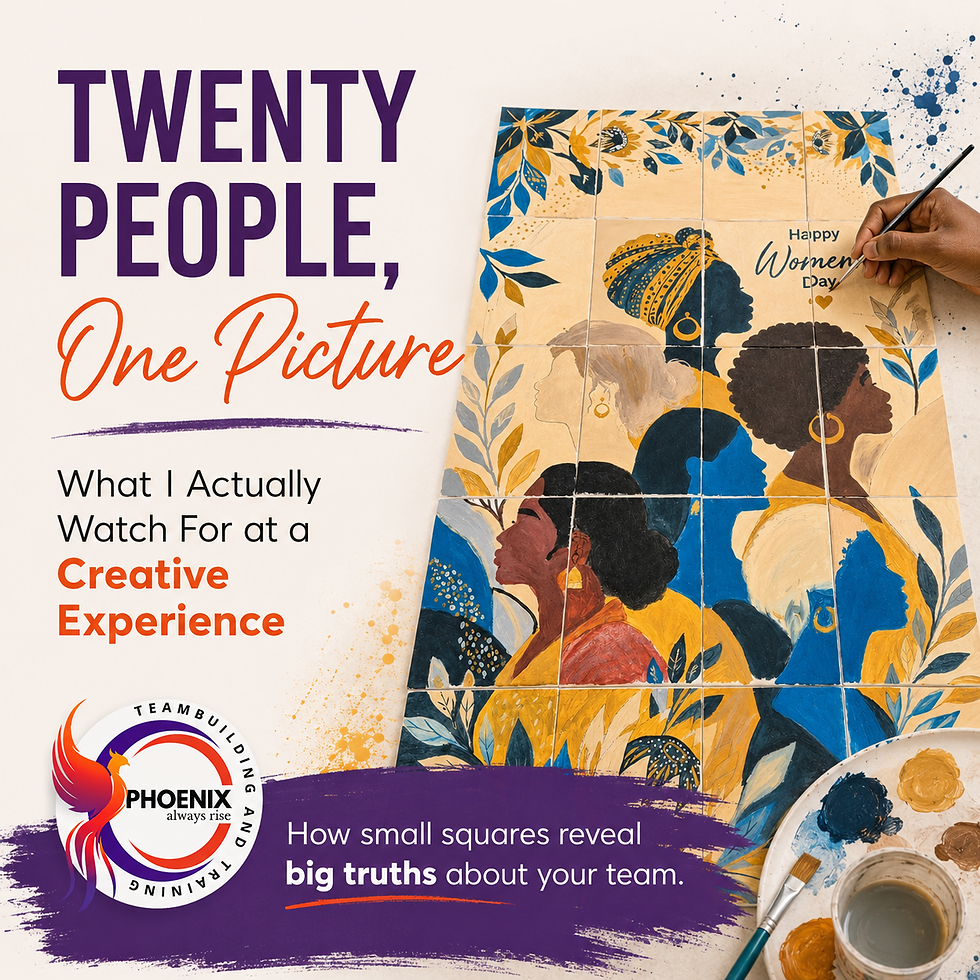
Before anyone walks in, I do the same thing every time. I go around the table and set a kit down at every seat - one blank canvas, a small palette, a pencil, a water cup, a square of paper towel - on e per person, waiting for them before they've event taken their jacket off. Then I put the reference image up where everyone can see it, and I stop pretending to be busy and just watch as this is not a typical "Sip and Paint" event, it is a Creative Big-Picture Teambuilding instead.
I'm watching to see who sits down and studies the whole picture first, and who reaches straight for the square already waiting in at their seat.
Because here's the thing about a creative teambuilding experiences like the Phoenix Tekkie Splash / Kennel-building, Mural Painting or events like a "Sip and Paint" style that surprises almost every HR manager, PA or team lead who books on for "Something fun before year-end": The wine, gin or whiskey and the paintbruhses are the least interesting part of the room.
What I'm actually running, dressed up as a corporate team building, is a two-hour, low-stakes simulation of how their business works. Or doens't.
Everyone gets the vision. Nobody gets ontrol of the whole thing.
Every person in the room sess the same reference image - the finished piece, in full colour,

before a sdingle brushtroke happens. That;s the strategy. Thats the Year-end target, the rband campaign, the five-year plan. Clear, shared, visible to everyone from the CEO's PA to the person from IT who "cant'd draw a straight line."
Even the paint itself isn't a free-for-all. Everyone's dippinginto the same small set of pre-mied, labelled bottles - a specific warm beige, a cool grey, a dustry gold that didn't officially exist until someone stirred it into being that morning. Nobody gets to invent thir own colour halfway through because it looks nice - that's brand guidelines and a shared budget in one breath, the same constraint every real team works inside of, whether or not anyone's ever said it out loud.
And then each person handed exactly one square of it. Not the whole thing. Not even a say in which piece they get. Just their suqre - a bit of a leaf, half a shoulder, three centimetres of somebody's earring - with instructions to make match a picture they didn't design and can't fully control.
This is the part that quietly unravels people, and it's the part I find most interesting to watch. Because it's precisely the gap between "I can see where we're going" and "I only control this one small square of getting there" that most teams live in every single day, and almost nobody names it out loud. This creative teambuilding event just makes it visible, with a paintbrush in your hand instead of a Gant Chart.
The Square nobody else can paint for you
Within the first ten minutes, the room always splits into two types of painter.
There's the person who commits to their square immediately - a bit messy, slightly off-rerence, but moving.
and there's the person who sits with the bursh hovering, asking me quietly, "What if I mess up the whole thing?"
That second question is the real one. It's not about paint. I've had directors ask it in a boardroom voice and interns ask it while looking at their shoes, and it comes from exactly the same place: the fear of being the one square that lets the picture down.

What I get to do, in that moment, is the same thing I'd want any good manager to do - I don't take the brush. I point out that the person two seats down painted their leaf the wrong shade of nacy twenty minutes ago, it's now everyone's favourite part of the mural, and nobody has noticed it wasn't "correct."
Permission to be imperfect and still contribute is not a soft skill. It's the entire reason some teams ship work and others sit in committee.
Watching the edges, not the middles
Here's what nobody tells you about a picture made of indiidual squares: the middle of your square is easy. It's the edges = where you leaf has to meet the neighbouring person's stem, were your line of gold dots needs to be continued into someone else's sky - that force people to actually talk to each other.
I watch for who leans over univtied to check their neigbour's progress. I watch for who paints their edge bodly and trusts the next person to meet it, versus who paints faintily and safely, heading against a mismatch they can't control. I watch for the person who quietly fixes the join between two squares that clearly weren't communicating, without being asked, without making it anyone's fault.
Tha behaviour has a name in every org chart I've ever seen. It's called cross-functional collaboration, and most companies pay consultants a great deal of money to try to teach it. I get to watch it happen organically over a shared water cup and plate of popcorn, between a receptionist and a regional manager who, twenty minutes earlier, had never really spoken to each other.
The room flattens itself and nobody has to be the one to do it.

Nobody at a Creative teambuilding activity like a "Sip and Paint' style event gets to hide behind a title. A director's brushwork is exactly as wobbly as a graduate's. Seniority buys you nothing in front of a blank canvas - and that, more than the wine, is what does the real work of the day. At one session, I watched a PA lean across and tell her regional director, mid-brushstroke - that his grey was too warm - "it needs more blue, that's more like the sea in the reference" - then correct her own square while she said it, not hesitation, no softening it into a question first. He said thanks and mixed a new batch. That exchange doesn't happen over email, and it doesn't happen in a meeting either - it needs a paintbrush in both people's hands first.
That kind of flattening doesn't need a "No titles today" icebreaker exercise.
The activity does it for you, because everyone is equally, visibly a beginner at the same thing, at the same table, at the same time.
This matters more than most team building budgets account for, and the numbers back it up.
South Africa's workplace engagement figures make for sober reading - Gallup's 2026 State of the Global Workplace put employee engagement here at 18% below the global average, and still falling.
Disengagement doesn't usually announce itself loudly. It looks exactly like this: People quietly doing the bare minimum inside their own square and never once looking up to check the edges. The antidote isn't a slogan on the office wall. It's an hour where people are physcally, literally required to look up from their own work and corrdinate with the person next to them - regardless of whether that person paints, codes, sells, or answers the phones for a living, and regardless of age, gender, or how long they've worked there.
The part that never makes it onto the invoice
Ask most people what they got out of a painting session and they'll mention the wine, or the fact that their square came out bettern than expected. What they usually don't mention - because nobody's asked them to notice it - is everthing else that happened along the way.
There's a focus. A brush forces a kind of attention that a phone doesn't allow, and I watch grown adults go quiet and still in a way meetings never seem to manage - forty minute sof single-tasking is rarer than it should be for most of the people in that room, and it shows on their faces by the end. There's a decision-making under uncertainty: which shade to try first, then to stop "fixing" that line that was already fine, how much to commit to before checking in. Small stakes, real practice. There's the confidence that comes from finishing something visible and tangible in an afternoon, in a working life where most ouput is digfital, delayed, or collective nenough that noone person can point to it and say "I made that square". And there's the cross-generational thing that happensalmost by accident - a 24 year-old and 58-year-old, from completly different departments, comparing brush techniques like colleagues ho've worked together for years, when an hour earlier they'd never spoken.
None of that show up on an invoice for "Teambuilding." All of it is why people remember the afternoon for a lot longer than they remember the training course that came before it.
When The squares finally meet.
Here's always a pause right before we lay the finished pieces out toegether. Nobody has seen the full picture assembled - only their own swuare of it, and whatever they glimpsed sideways from their neighbours.
And then the squares go down, edge to edge, and the room does the thing I never get tired of watching: twenty seprarate, slightly imperfect, individually anxious contributions resolve into one picture that is, without exception, better than anyone in the room expeted their own square to be.
That's not a metaphor I'm forcing onto the evening after the fact. It's the actual mechanics of the thing. Nobody's individual square is the masterpiece. The commitment of every single person to finish their own square, match their edges ,and trust thie person next to them to do the same - that's the mastrepiece. It is also, not coincidentially, a fairly accurate description of ho a department, a project team, or a whole company actually delivers anything worth delivery.
What this means if you're the one who has to book the "fun thing"
If you're the PA sourcing quotes, the team lead trying to justify the spend, or the HR or people-and-culture manager weighing this against yet another lecture-style traning, here's what I'd want you to know:
You're not choosing between "serious development" and
"a nice afternoon out:
A well-run creaive team sessions is allive audit of how your people actually communicate, hedge, take ownership, and support each other, without anyong feeling watched or assessed.

You'll learn more about who quietly leads and who quietly carries the group in two hours of painting than in most half-day workshops - and your team gets to walk away with a piece of art they made together, instead of a workbook nobody reopens. We've run this across teams of eight and teams of thirty, In boardrooms from Cape Town to
Johannesburg, for people who told me at the door they "were not creative" and then spent the last twenty minutes refusing to put their brush down. It works because it was never really about the paint.
If any of that sounds like the team you're trying to get something right for, the easiest next step isn't a brochure- it's a conversation. Tell me your group size, your dates, and what you're actually hoping hte afternoon does for your people, and I'll put together a proper quote for your team, not a generic package.
#PhoenixTeamBuilding #CreativeExperiences #TeamDevelopment #TeamPerformance #CorporateEvents #SouthAfrica #TeamBuildingSouthAfrica #CreativeTeamBuilding #ConferenceEvents #PCO #EventPlanning

Comments